



Highlights
-
Portable educational PET scanner for exploring the principles of Positron Emission Tomography
-
Detection of the two back-to-back 511 keV photons from positron annihilation
-
Two-dimensional image reconstruction of a radioactive source, in real time during acquisition
-
Experiments on gamma spectroscopy, system linearity, spatial resolution and efficiency
-
Same basic detector technology as state-of-the-art PET systems, based on Silicon Photomultipliers (SiPM)
-
EasyPET Control Software with graphical user interface, USB connection
Overview
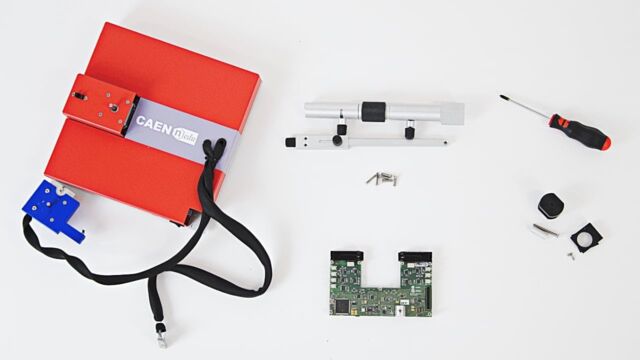
Positron Emission Tomography (PET) is one of the most advanced medical imaging techniques. It provides detailed functional information on physiological processes inside the human body, and it plays a major role in cancer diagnosis, therapy monitoring and drug development. The SP5700 EasyPET brings this technology into the teaching lab. It is a simple, portable PET system designed for higher education, which lets students explore the physical and technological principles of clinical PET scanners, using the same basic detectors as state-of-the-art systems.
PET is based on a chemical marker labelled with a positron-emitting radioisotope and administered to the patient. Each emitted positron annihilates with an atomic electron, producing two 511 keV photons that travel in opposite directions. In a clinical scanner, a ring of detectors surrounding the patient records these photon pairs in coincidence, and the image is reconstructed from the lines that connect each pair of detection points. With EasyPET, students reproduce this process step by step on a radioactive source and see how a PET image takes shape from individual coincidence events.
The system is operated through the EasyPET Control Software, a desktop application with an intuitive graphical interface, connected to the scanner via USB. Students configure acquisition parameters, calibrate the detectors and follow the image reconstruction in real time while the acquisition is running. Data can be recorded and exported for offline analysis.
The experimental path starts with gamma spectroscopy and the verification of system linearity. It continues with the detection of positron annihilation and the two-dimensional reconstruction of a radioactive source. Students then characterize the system, measuring its spatial resolution and detection efficiency, and gain hands-on experience with the methods used in modern nuclear imaging.
Video
CAEN Educational Tutorial - EasyPET SP5700
You also may be interested in…

Request a Quote

Compare

|
Image
|
Name
|
Statistics
|
SiPM Characterization
|
Photons
|
Cosmic Rays
|
Gamma Spectroscopy
|
Beta Spectroscopy
|
Nuclear Imaging
|
Environmental Radioactivity Indoor
|
Environmental Radioactivity Outdoor
|
Pulse Processing
|
|

|
SP5700 |
⚫ |
- |
- |
- |
- |
- |
⚫ |
- |
⚫ |
- |
|

|
SP5660 – RockyRad |
⚫ |
- |
- |
- |
⚫ |
- |
- |
- |
⚫ |
|
|

|
SP5640 |
⚫ |
- |
- |
- |
⚫ |
- |
- |
- |
⚫ |
- |
|

|
SP5630EN |
⚫ |
- |
- |
- |
- |
- |
- |
⚫ |
- |
- |
|

|
SP5600EMU |
⚫ |
- |
- |
- |
⚫ |
- |
- |
- |
- |
⚫ |
|

|
SP5630ENP |
⚫ |
- |
- |
- |
⚫ |
- |
- |
⚫ |
- |
|
|

|
SP5701 |
⚫ |
- |
- |
- |
⚫ |
- |
- |
- |
⚫ |
- |
|

|
SP5600E |
⚫ |
⚫ |
⚫ |
- |
- |
- |
- |
- |
- |
- |
|

|
SP5650 |
⚫ |
- |
- |
- |
⚫ |
- |
- |
- |
- |
- |
|

|
SP5620CH |
⚫ |
- |
- |
⚫ |
- |
- |
- |
- |
- |
- |
|

|
SP5600D |
⚫ |
- |
- |
⚫ |
- |
⚫ |
- |
- |
- |
- |
|

|
SP5600C |
⚫ |
- |
- |
- |
⚫ |
- |
- |
⚫ |
- |
- |
Technical Specifications
|
nan |
|
Footer