
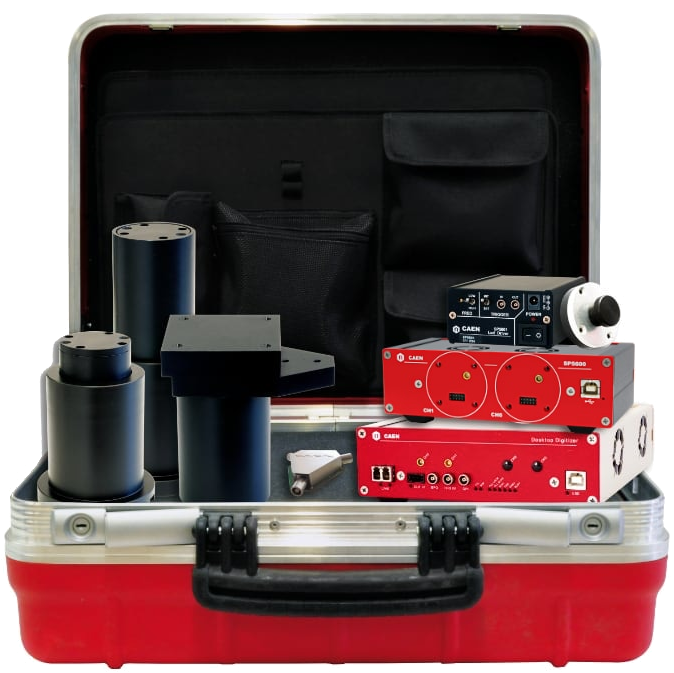
SP5600EMU Emulation Kit
Highlights
-
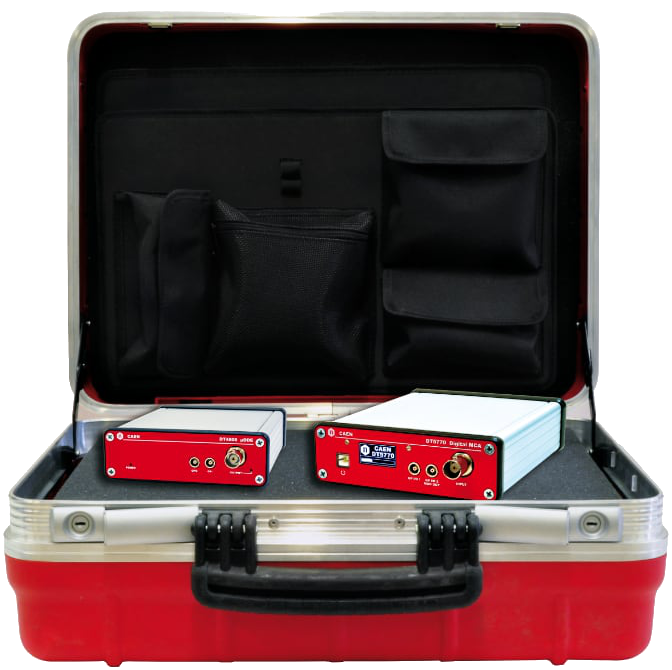
Educational kit for nuclear spectroscopy experiments with no radioactive source and no detector
-
DT4800 Micro Digital Detector Emulator: realistic energy spectra, noise and Poissonian time distribution
-
DT5770 Digital MCA (14 bit, 150 MS/s) with digital pulse processing
-
Experiments on gamma and alpha spectroscopy, system linearity, statistics and pulse processing
-
Emulation Control Software: a single interface to drive both the emulator and the MCA
Overview
A spectroscopy lab usually needs a detector and a radioactive source. The SP5600EMU Emulation Kit needs neither. It reproduces the signals that particles generate when they interact with a detector, so students can carry out a full series of experiments in any classroom, with no safety constraints, no licensing and no source handling. Because every parameter of the signal is under their control, they can also isolate one effect at a time and see exactly how it changes the measurement.
The signals are generated by the DT4800 Micro Digital Detector Emulator, the most compact model of the CAEN Detector Emulator family, designed for educational use. Its single analog output produces exponential pulses with programmable rise and fall times, at rates up to 1 Mcps. The rate can be constant or follow a Poisson distribution, as in a real radioactive decay. The emulator can reproduce a single energy line or a complete energy spectrum, add white and random-walk noise, and emulate the continuous output of a preamplifier.
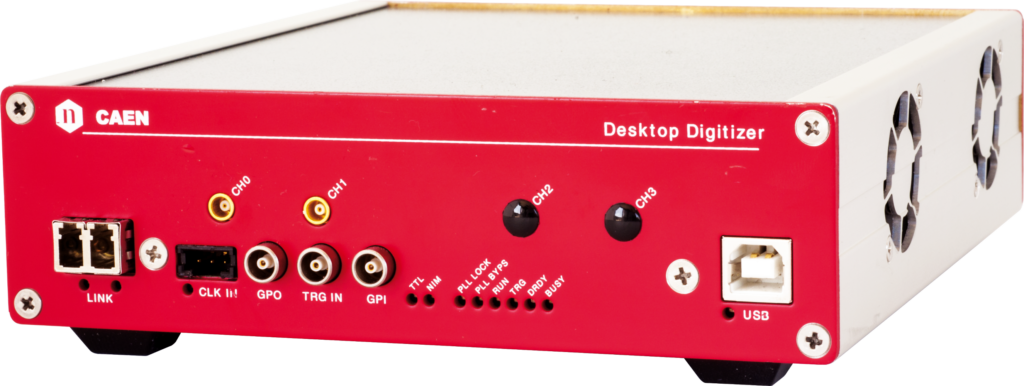
These signals are acquired by the DT5770, a compact Digital Multi-Channel Analyzer for gamma spectroscopy. It integrates an analog front end with programmable gain and a 14-bit, 150 MS/s digitizer, and processes signals digitally with pole-zero cancellation, pile-up rejection, live time correction and baseline restoration. Designed for high-resolution semiconductor detectors such as HPGe and Silicon Drift Detectors, it can also work with scintillators coupled to photomultipliers.
Both instruments are controlled through the Emulation Control Software, a single graphical interface for quick setup. On the emulator side, students set the rate, amplitude, rise and fall times of the pulses and the noise contributions. On the MCA side, they choose between threshold and trapezoidal triggering, select charge integration or a trapezoidal filter for energy measurement, and control baseline calculation and pile-up rejection. With this setup, students explore gamma and alpha spectroscopy, system linearity and counting statistics, and learn how each stage of digital pulse processing shapes the final spectrum.
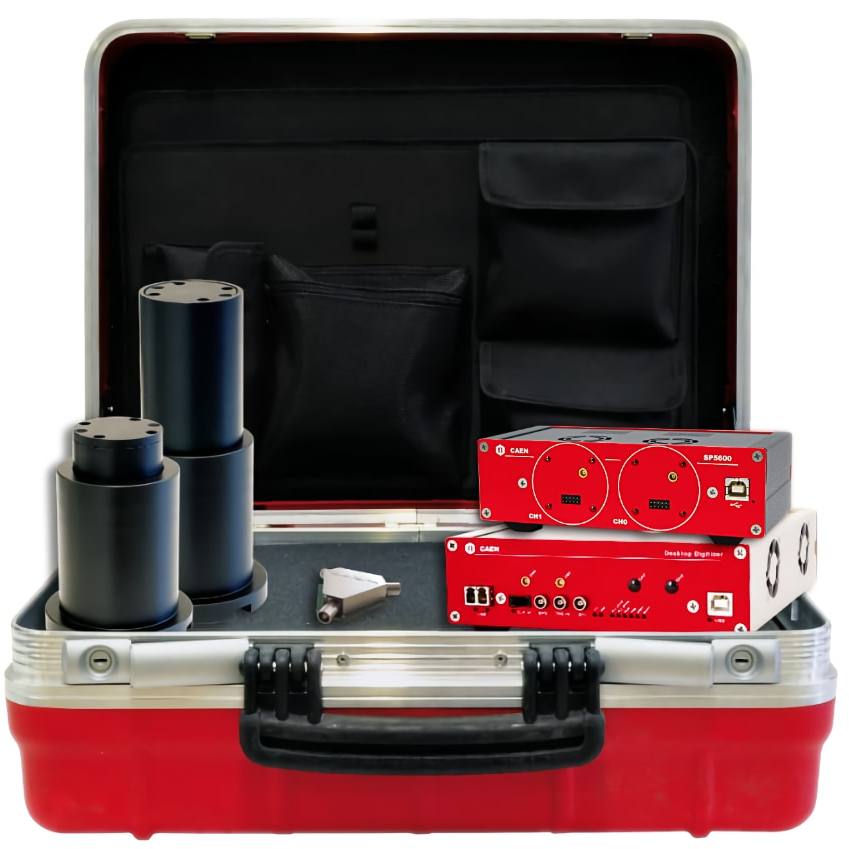
You also may be interested in…
Request a Quote

Technical Specifications

|
DT4800 Micro Digital Detector Emulator |
|
||
|
DT5770 Digital Multi Channel Analyzer - Desktop |
|
Footer